Local-first product · AI image workflow
A local image studio built to stay maintainable.
Z-Image-Turbo-Next wraps a local image model in a focused creative workspace with six generation modes, persistent story batches, explicit resource control, and release-ready rollback points.
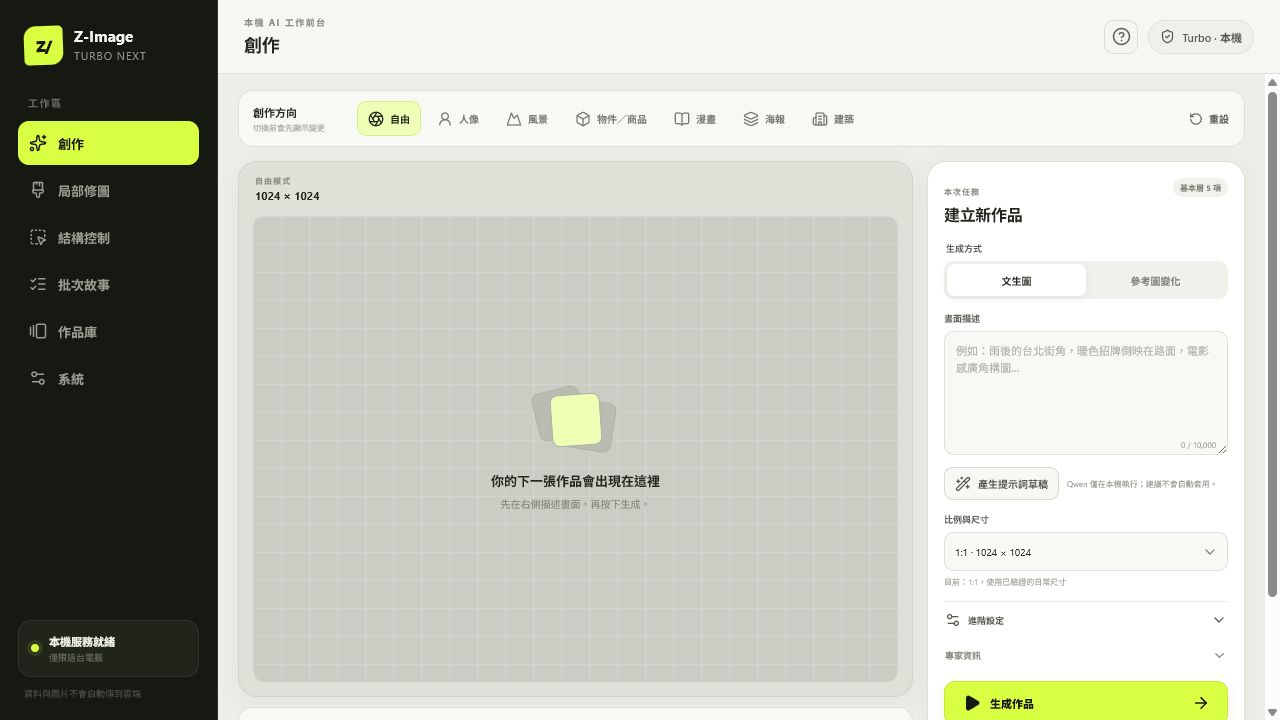
The interface image is a read-only capture of an empty workspace. It contains no work history, private paths, account details, or source repository link.
01 · Product system
The model became a product when the workflow gained boundaries.
The front end stays on one local origin while typed workflows coordinate text-to-image, image variation, Canny, Depth, Pose, and Inpaint. A single resource manager prevents local language assistance and image generation from competing for heavy resources.
Focused workspace
Creation, retouching, structural control, stories, the library, and system state remain separate but reachable.
Typed workflows
Each generation mode has an explicit versioned contract, validated dimensions, and visible settings.
Persistent queue
Story shots, attempts, output hashes, pauses, retries, and backups survive restarts in a local SQLite queue.
Rollback-ready release
Pinned runtimes, health checks, stop/start validation, and version tags keep the daily entry point recoverable.
02 · Verified evidence
Release claims come from versioned tests—not a polished screenshot.
Version 1.2.1 passed its full local release gate. Performance figures below are warm-run medians from one fixed local Windows GPU environment, with one cold run and three consecutive warm runs at each supported size.
Generated story evidence
Fifteen planned scenes became a complete picture book.
“The Promise at the Twilight Platform” demonstrates the end-to-end story workflow: text-only planning, per-shot visible characters, editable prompts, persistent batches, local generation, and final layout. It also exposes consistency drift instead of hiding it.

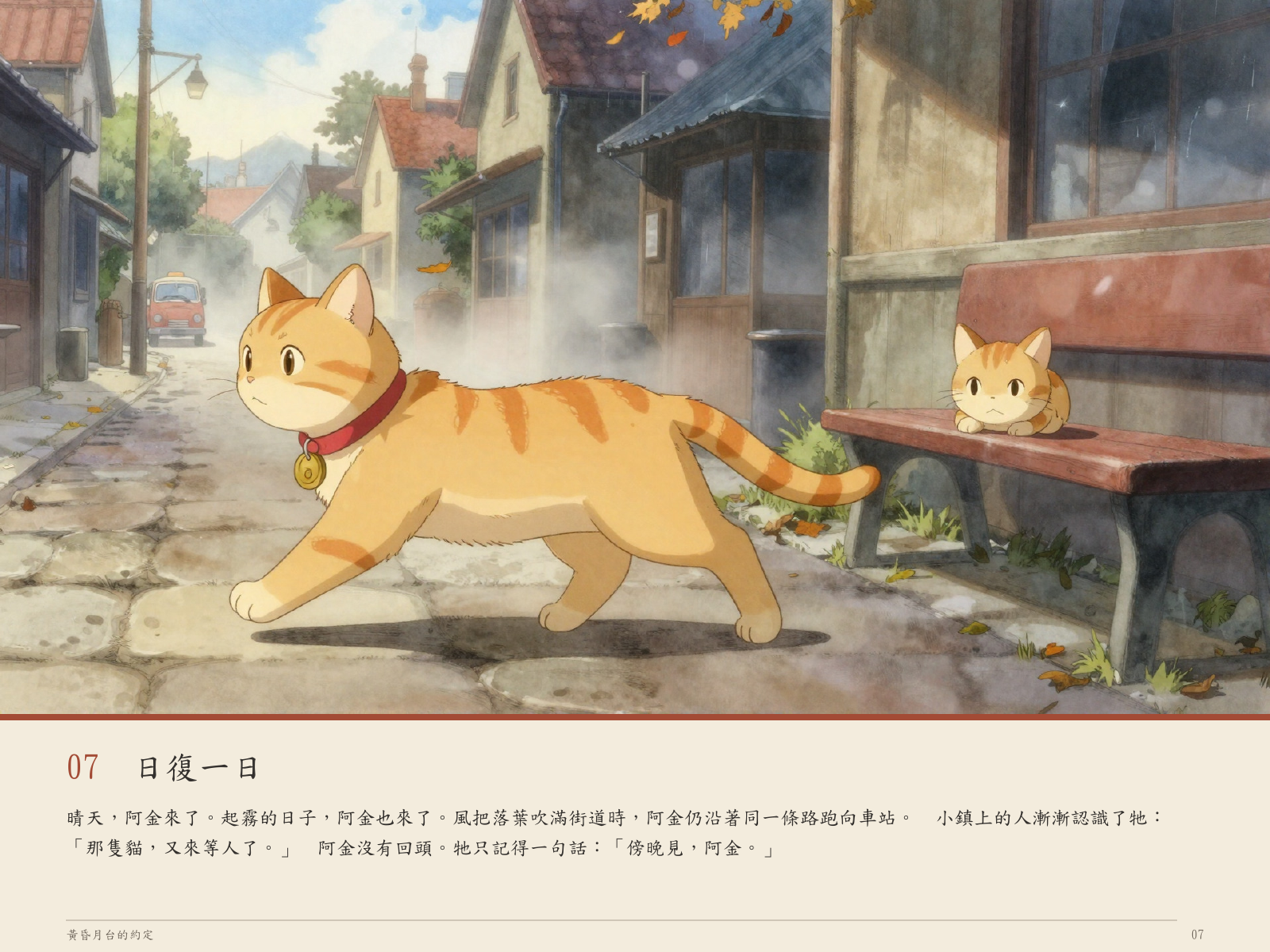
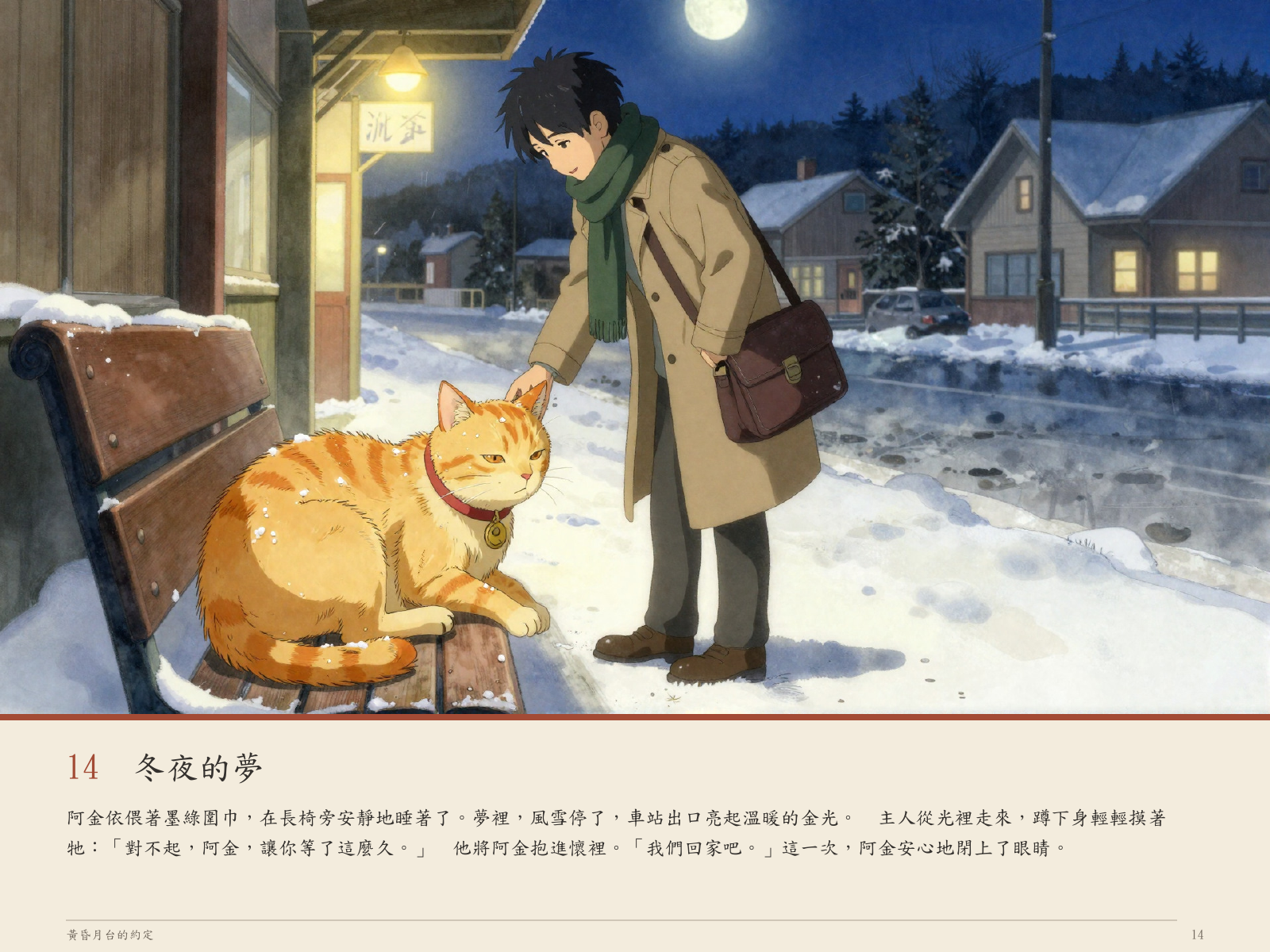
Selected pages from a user-provided project output. No real person, private photo, account, local path, or original database is published.
03 · Publication boundary
Private source. Local models. Public proof.
The complete application source is stored in a private repository. Model weights, the portable runtime, the ComfyUI checkout, databases, inputs, outputs, logs, caches, and account state are excluded from version control and from this public case.
Source repository access, local paths, formal data, work history, raw databases, account state, and device identifiers.
Model weights, image generation, Qwen assistance, the persistent queue, and all source or output media.
Product decisions, sanitized interface evidence, selected generated pages, aggregate tests, benchmark context, and known limits.
04 · Honest quality boundary
The workflow is reliable. The generative model is still probabilistic.
The application can preserve plans, prompts, queues, outputs, and rollback points. It cannot promise identical characters, scenes, composition, or style across independently sampled images.
Character markings, scale, wardrobe, location details, and art direction can drift between story frames.
Turbo image-to-image is useful for guided variation, not guaranteed pixel-precise natural-language editing.
Timing is machine- and workload-specific. Extreme 3312² output is evidence only, not a daily preset or product promise.
Delivery result
A finished local tool, with its limits still visible.
In roughly 24 hours of development, the project moved from a working local model to a maintainable creative product with explicit privacy, evidence, and rollback boundaries.
Development time was provided by the project owner; test counts and performance figures come from versioned local release evidence.
Back to top ↑